

If you’re shopping for a 48-inch professional induction range, there’s a good chance you’ve come across two names: Wolf and Fulgor Milano. Both are serious appliances aimed at serious home cooks, and both will transform the way you work in the kitchen. But they take meaningfully different approaches, and the right choice depends on what you actually value.
This post breaks down the Wolf IR48751SP against the Fulgor Milano F6PIR487S1 and F6PIR485GS1 side by side. No filter, just the specs, the tradeoffs, and what they mean for how you cook. We’ll start from the top with the induction rangetop.
The Induction Rangetop

Fulgor Milano offers two versions of the Sofia 48-inch induction range, and it’s worth clarifying the difference upfront. The F6PIR487S1 and F6PIR485GS1 are essentially the same range — same dual oven, same dimensions, same feature set — the only difference is the cooktop configuration. The F6PIR487S1 gives you seven open induction zones across a full ceramic glass surface. The second model, the Fulgor F6PIR485GS1 replaces two of those zones with a built-in trilaminate stainless steel griddle, leaving you with five open zones plus the griddle. Both models run on 7 total induction elements underneath, and the griddle is removable — so if you want the full cooktop back, you can have it. If you regularly cook bacon, smash burgers, pancakes, or anything else that benefits from a flat surface, this is a genuinely useful feature — and it’s unique in this category. No other 48-inch pro induction range offers an integrated griddle like this.
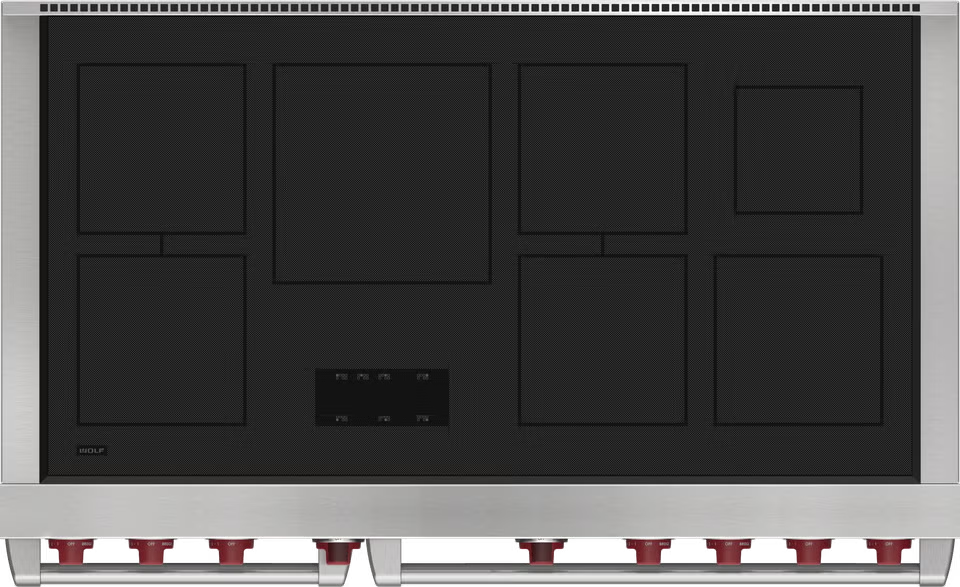
The Wolf IR48751SP is equipped with seven induction zones. The standout is the center element, which delivers up to 5,500 watts in Boost Mode — enough to bring a large stockpot to a rolling boil faster than most professional gas burners. The six surrounding zones each reach 3,700 watts, which is itself more power than the hottest residential gas burner on the market. Every zone has its own Boost Mode, and a bridge function lets you link two adjacent zones into one larger surface for griddles, roasters, or fish poachers.
Fulgor Milano’s element outputs break down as follows: the middle dual-circuit element reaches 5,500 watts (matching Wolf’s peak), the front left and front right zones each deliver 3,700 watts (matching Wolf’s standard zones), the rear left and rear right come in at 3,000 watts each, the middle single-circuit element sits at 2,600 watts, and the bridge zone runs at 3,000 watts. That’s a more competitive lineup than it might appear at first glance — two of Fulgor’s zones match Wolf’s 3,700-watt standard, and both ranges hit the same 5,500-watt ceiling. Wolf does have an edge in overall consistency, with six zones at 3,700 watts versus Fulgor’s two, but the gap is narrower than a simple headline comparison suggests.
Edge: Wolf on per-zone consistency across the full cooktop. Both hit 5,500W at peak, and Fulgor matches Wolf’s 3,700W on two of its seven zones. Fulgor F6PIR485GS1 on versatility with the integrated griddle.
The Ovens
Both brands offer dual ovens, one larger cavity on the right and one smaller on the left, which is the standard configuration for most 48-inch pro ranges. But the numbers tell different stories depending on how you look at them.
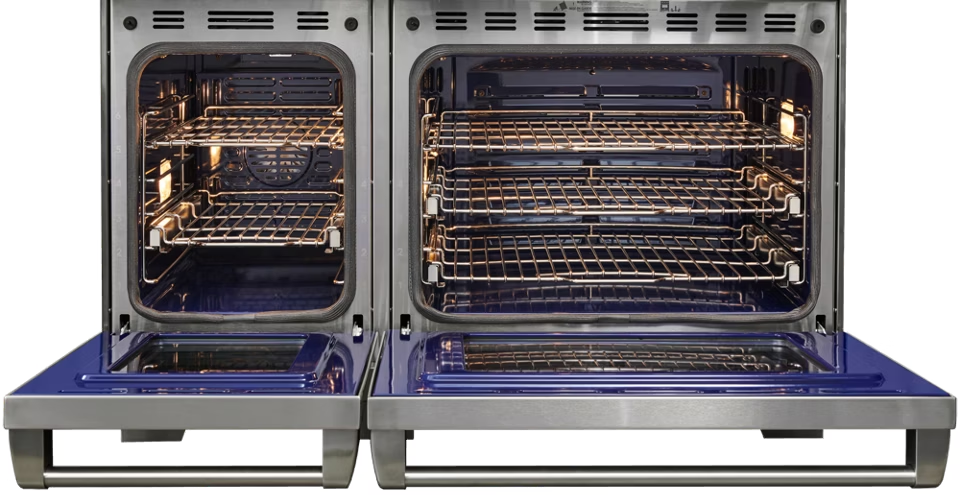
Wolf claims approximately 7.8 cubic feet of total overall capacity (5.1 in the main oven, 2.7 in the secondary). Here’s something worth knowing: Wolf also publishes usable capacity, which reflects actual accessible cooking space after accounting for rack supports and door clearance. Those numbers are 3.2 and 1.8 cubic feet respectively. Most brands don’t disclose usable capacity at all, so comparing Wolf’s usable figures to a competitor’s overall figures is apples to oranges. It’s a transparency point in Wolf’s favor, but it does mean the main oven’s real working space is closer to 3.2 cubic feet than the headline 5.1.

Fulgor Milano’s total capacity across both ovens is 7.1 cubic feet (4.4 in the primary, 2.7 in the secondary). These are overall figures, and usable capacity isn’t published, which is typical for the industry.
Both the Wolf and the Fulgor Milano ranges use dual true convection systems that circulate heat with a dedicated fan and heating element, reducing hot spots and enabling consistent multi-rack cooking. Where Wolf pulls ahead is in cooking modes and intelligence. The IR48751SP offers 10 preset modes — Bake, Broil, Convection, Convection Roast, Dehydrate, Gourmet, Proof, Roast, Stone, and Warm — plus Gourmet Mode, which includes nearly 50 automated presets. Select the dish, and the oven sets the mode, temperature, and rack position for you. It also adjusts on its own during cooking.
Fulgor’s oven is more traditional. You get the standard bake, broil, and convection functions, plus a meat probe and self-clean — everything you need, nothing you don’t. If you’re the kind of cook who knows what temperature you want and sets it yourself, you won’t miss the presets. If you want guided cooking or the ability to hand off decisions to the oven, Wolf has a significant advantage here.
Both ranges include a meat probe, self-clean mode, and Sabbath mode. Fulgor adds soft-close oven doors, which Wolf doesn’t have. It’s a small detail, but a noticeable one in daily use.
Edge: Wolf on cooking modes and guided features. Fulgor on simplicity and oven door quality.
Controls and Smart Features
This is where the two brands diverge most clearly in philosophy.
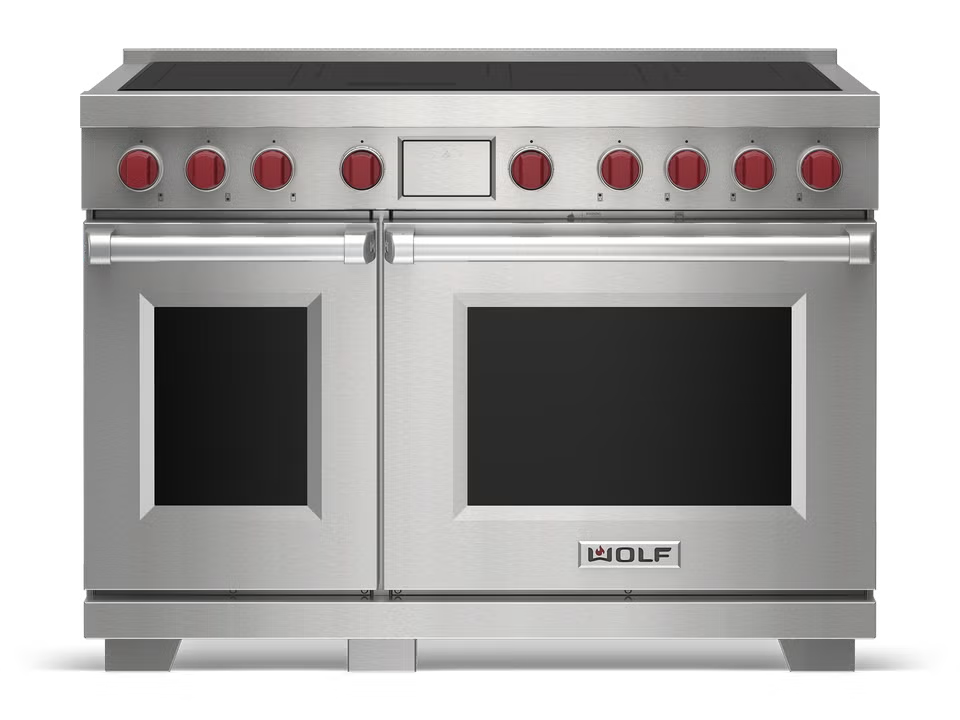
Wolf has moved its controls to the front face of the range and centered them around a full-color touchscreen. It’s intuitive, easy to read, and lockable for cleaning. The knobs are still there for cooktop control — a deliberate nod to the tactile experience of cooking with gas — but the oven is primarily touch-driven. The range is Wi-Fi enabled, meaning you can preheat, change temperatures, and select cooking modes remotely through the Wolf Owners’ App. For buyers who want that level of connectivity, it’s a genuinely useful feature.

Fulgor Milano takes the opposite approach. The Sofia is knob-controlled throughout, with no touchscreen and no app connectivity. For many cooks, that’s not a drawback — it’s a preference. Knobs are tactile, immediate, and never require a software update. If you want a range that behaves like a professional tool rather than a connected device, Fulgor’s interface is refreshing in its simplicity.
Wolf also offers significant personalization on the exterior: 10 combinations of knob colors (including the signature red, plus black and stainless) and bezel finishes. If your kitchen has a specific aesthetic, that level of customization matters. Fulgor’s styling is clean and Italian — handsome, but without the same degree of personalization.
Edge: Wolf on technology and customization. Fulgor on simplicity and tactile control.
Installation: The Detail That Can Make or Break a Project
This is arguably the most important practical consideration for the Wolf, and it needs to be addressed early in any project conversation.
The Wolf IR48751SP requires two dedicated 50-amp circuits — 100 amps total for a single appliance. That’s more electrical capacity than any other consumer range currently on the market. If your home’s panel isn’t already configured for that load, you’re looking at a real electrical project before the range ever gets installed. For a new build or a full kitchen renovation, this is manageable. For an existing kitchen, it may require an electrical panel upgrade, which adds both cost and timeline.
Both Fulgor models run on a single 50-amp, 240V circuit, which is the standard configuration for a high-end freestanding range. In most homes, the infrastructure is already there or easily accommodated. To accommodate high-demand performance, Fulgor has built in a proprietary Power Management System: if the total draw exceeds 50 amps (usually when both ovens are running and all surface elements are at maximum simultaneously) the system temporarily reduces power to four of the five main cooking zones to protect the circuit breaker. Fulgor notes this scenario is unlikely in normal daily use, and it’s not how the range achieves its 5,500W peak output. But for buyers who genuinely cook at full capacity regularly, Wolf’s dual-circuit headroom is a real functional advantage, not just a spec on paper.
Both Wolf and Fulgor share the same footprint: 47⅞ inches wide and 30 inches deep (Wolf is slightly shallower at 29½ inches).
Edge: Fulgor on installation simplicity for most kitchens. Wolf on sustained high-demand performance.
Which One Is Right for You?
There’s really no bad choice here. These are both excellent ranges built to last, and either one will be the centerpiece of a serious kitchen.
Choose the Wolf IR48751SP if you want the most technologically advanced induction range available, cook in the Sub-Zero/Wolf/Cove ecosystem, value smart features and guided cooking modes, and have — or are willing to invest in — the electrical infrastructure to support it.
Choose the Fulgor F6PIR487S1 if you want a knob-driven, Italian-designed induction range with generous oven capacity, soft-close doors, and a straightforward installation. It’s the value play in this comparison without feeling like a compromise.
Choose the Fulgor F6PIR485GS1 if everything above applies and you also want a built-in griddle. It’s a unique feature in the 48-inch pro induction category, and the removable design means you’re not giving anything up if you decide not to use it.
Come See Them in Person
Reading specs is a good start, but there’s no substitute for standing in front of these ranges and getting a feel for the controls, the build quality, and how they’d actually live in your kitchen. At The Kitchenworks, we carry Wolf and Fulgor Milano and are happy to walk you through both without the sales pressure. Stop by our Fort Lauderdale showroom or reach out — we’re here to help you make the right call for your home.


Leave a Reply